
What You Need to Know About Molokini Crater Hawaii
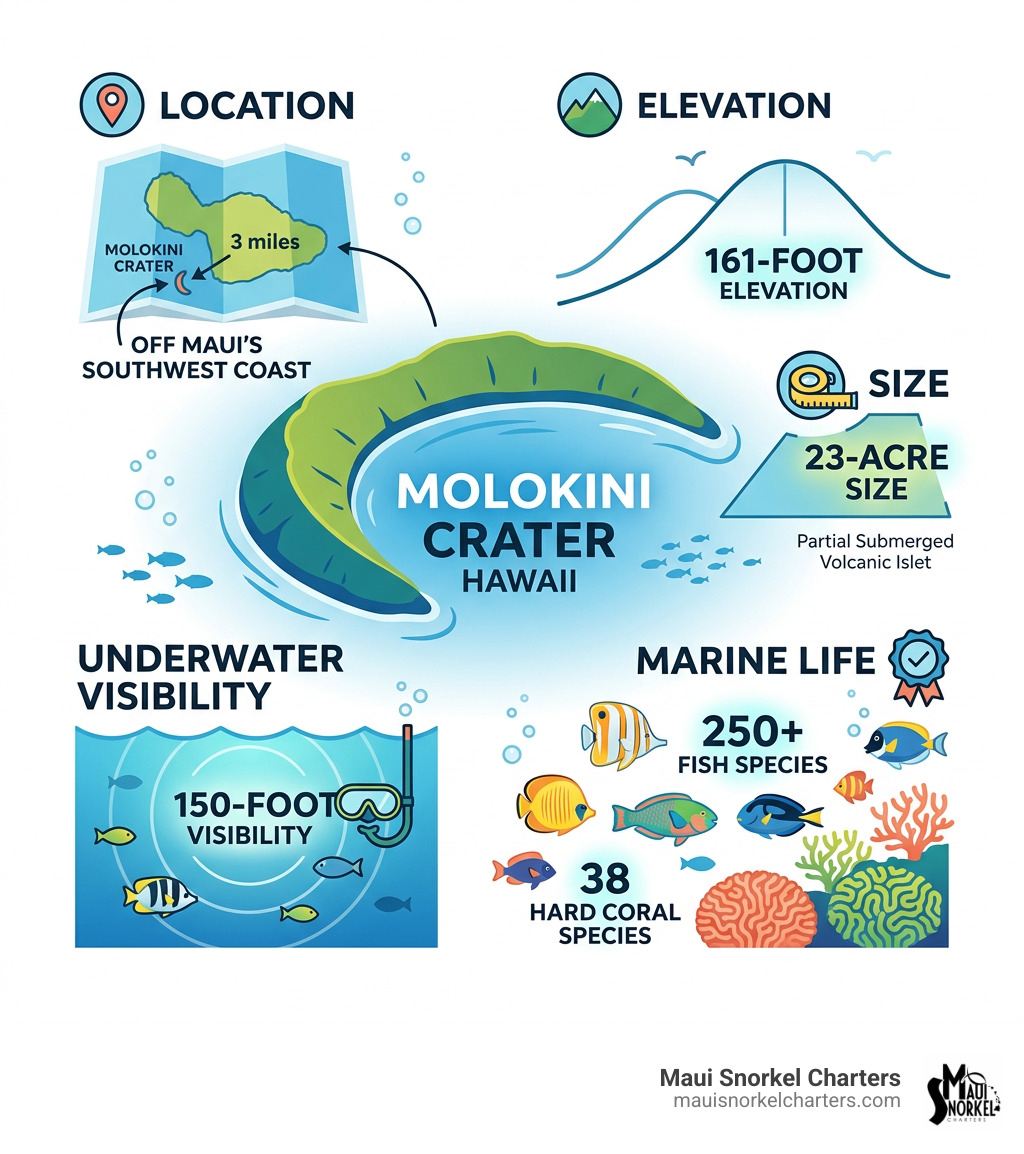
Molokini Crater Hawaii is a crescent-shaped, partially submerged volcanic islet located about 3 miles off Maui’s southwestern coast, in the ʻAlalākeiki Channel between Maui and Kahoʻolawe. It is one of the most popular snorkeling and scuba diving destinations in the state.
Here’s a quick overview:
| Feature | Details |
|---|---|
| Location | 3 miles off Maui’s southwestern coast |
| Shape | Crescent moon (partially submerged volcanic crater) |
| Size | 23 acres, 161 feet above sea level |
| Visibility | Up to 150 feet underwater |
| Marine Life | 250+ fish species, 38 hard coral species |
| Protection Status | Marine Life Conservation District since 1977 |
| Annual Visitors | Over 300,000 |
| Access | By boat only, departing from Ma’alaea Harbor |
Millions of travelers come to Maui each year, and Molokini consistently tops the list of things not to miss. And for good reason — the calm, clear water inside the crater’s protected cove creates snorkeling conditions you simply won’t find from shore.
But it’s not just a pretty reef. Molokini has a rich history — from ancient Hawaiian fishing grounds to WWII bombing practice, and ultimately to a protected marine sanctuary. Understanding what it is, how to get there, and what to expect will help you make the most of your visit.
This guide covers everything: the geology, the marine life, the rules, the logistics, and honest advice on whether it’s worth it for your group.
We’re Maui Snorkel Charters a unique tour company in Hawaiʻi with years of experience navigating the waters around Molokini Crater Hawaii. Our goal with this guide is to give you the same local knowledge we share with guests on every tour — so you can plan your trip with confidence.
Molokini crater hawaii terms made easy:
What is Molokini Crater Hawaii?
At its core, Molokini Crater Hawaii is a submerged volcanic caldera. While it looks like a tiny island, it is actually the rim of a much larger volcanic structure that rises 500 feet from the flank of Haleakala. Only the top 161 feet peak above the ocean surface, creating a 23-acre islet that serves as a natural breakwater.
Located approximately 2.5 miles west of Makena State Park and 3 miles off Maui’s southwestern shore, its unique crescent shape is its most famous feature. This “moon” shape acts as a shield, blocking the heavy swells and currents of the Alalakeiki Channel. This creates a sanctuary of calm, crystal-clear water inside the cove, making it one of the safest and most visually stunning places to snorkel in the world.
Because it is an islet with no soil or sandy beaches, there is no sediment runoff to cloud the water. This is why visibility often exceeds 100 to 150 feet, allowing you to see the sprawling coral gardens in high definition.
Check availability for our Molokini Crater snorkel tour
Geological History and Formation
The story of Molokini began approximately 230,000 years ago. Geologists believe it formed during a period of intense volcanic activity when the Maui landmass moved over a tectonic hot spot. It is a classic example of a “cinder cone” eruption.
As the volcano erupted underwater, the contact between hot lava and cold seawater caused explosive reactions, piling up ash and rock into the circular shape we see today. Over hundreds of thousands of years, the northern rim of the crater eroded and eventually submerged, leaving behind the iconic crescent.
Scientific research using potassium-argon dating has confirmed these prehistoric origins, linking Molokini to the same volcanic system that formed the larger “Maui Nui” landmass. For more technical details, you can explore the scientific research on Molokini’s volcanic origins.
Hawaiian Mythology and the Legend of Pele
Long before modern geology, Native Hawaiians explained the crater’s existence through rich oral traditions. The most famous legend involves Pele, the fire goddess, and a beautiful Mo’o (lizard-woman) named Molokini.
According to the legend, both Pele and the Mo’o fell in love with the same handsome prince. In a fit of jealous rage, Pele cut her rival in two. The Mo’o’s head became the cinder cone known as Pu’u Olai (located at Makena State Park), and her body became the islet of Molokini. The name “Molokini” itself translates to “many ties,” perhaps referring to the numerous cord-like structures seen in the volcanic rock or the many ties to Hawaiian history.
Marine Life and Ecosystems of the Crater
The ecosystem at Molokini Crater Hawaii is incredibly diverse. Because it has been protected for decades, the marine life here is unafraid of humans, often swimming right up to snorkelers.
The crater is home to:
- Over 250 species of tropical fish.
- 38 distinct species of hard corals.
- Approximately 100 species of marine algae.
The visibility is so high that you can see the “kaleidoscope of coral” clearly from the surface. The inner cove slopes to a depth of about 100 feet, but the most vibrant reef activity happens in the 20 to 50-foot range.

Explore the animal life around Molokini
Rare Species at Molokini Crater Hawaii
While the “regulars” like Yellow Tang and the Humuhumunukunukuapua’a (Hawaii’s state fish) are everywhere, lucky visitors often spot larger, rarer residents.
- Manta Rays: These majestic giants are occasionally seen gliding through the deeper parts of the crater.
- Monk Seals: The endangered Hawaiian Monk Seal sometimes hauls out on the rocky shoreline to rest.
- Whale Sharks: Though rare, these gentle giants have been spotted near the outer rim.
- Sharks: You might see small, docile Whitetip Reef Sharks resting in sandy patches or under coral ledges.
The Hawaii State Seabird Sanctuary
Molokini isn’t just a sanctuary below the waves; it’s also a vital habitat above them. The islet is a designated Hawaii State Seabird Sanctuary, hosting over 1,000 pairs of nesting birds.
The steep, rocky cliffs provide the perfect nesting ground for:
- Wedge-tailed Shearwaters: The primary nesting species on the island.
- Bulwer’s Petrels: Smaller seabirds that burrow into the volcanic rock.
- Frigate Birds (Iwa): Known as “thieves” in Hawaiian, these birds have a wingspan of up to 7 feet and are famous for stealing food from other birds mid-air.
Because of this sanctuary status, landing on the island is strictly prohibited to protect the fragile nesting sites.
Snorkeling Experiences at Molokini
When you visit with us, the experience usually centers around the Inner Crater. This is the classic snorkeling spot—calm, shallow (20-50 feet), and teeming with life. It is the best place for beginners to practice their buoyancy and for families to enjoy a safe environment.
For more experienced enthusiasts, the Back Wall is a world-class geological feature. This is the backside of the crescent, where the wall drops vertically to depths of over 300 feet. It is often rated as one of the top 100 dive sites in the world. While snorkeling is possible here on very calm days, it is primarily a “drift dive” for advanced scuba divers who want to see larger pelagic fish and dramatic underwater drop-offs.
More info about Molokini Crater snorkeling
Best Time to Visit and Water Conditions
Timing is everything when it comes to Molokini Crater Hawaii.
- Early Morning is Best: We recommend the earliest tours possible (usually departing around 7:00 AM). The trade winds typically pick up in the afternoon, which can make the boat ride choppy and the water inside the crater less clear.
- Winter Bonus: If you visit between December and April, your snorkel trip doubles as a whale-watching tour. Humpback whales migrate to these warm waters, and it’s common to see them breaching on the way to the crater.
- Underwater Acoustics: During whale season, if you dip your ears below the surface at Molokini, you can often hear the haunting songs of the whales echoing through the water.
Conservation, History, and Access Rules
Molokini’s pristine state is the result of strict legal protections. In 1977, it was designated a Marine Life Conservation District (MLCD). This 77-acre protected area ensures that the reef remains healthy for future generations.
The Rules of the MLCD:
- No Fishing: Taking any marine life, including shells or rocks, is strictly forbidden.
- No Feeding: Feeding the fish is illegal as it disrupts their natural diet and behavior.
- No Landing: You cannot walk on the islet without special permits from the U.S. Coast Guard and the Hawaii Division of Forestry and Wildlife.
The complete guide to Molokini Crater snorkeling
Protecting the Reef: Mooring and Permits
One of the biggest threats to coral reefs is boat anchors. To prevent damage, the state installed a permanent mooring system. There are approximately 20 mooring buoys available for commercial and private vessels.
These buoys are highly regulated. In recent years, there have been proposals to reduce the number of moorings to 12 to further limit the human impact on the reef. By using these buoys, we ensure that our boat, the No Ka Oi, never has to drop an anchor on the delicate coral.
WWII History and Restoration
It’s hard to imagine now, but during World War II, the U.S. Navy used Molokini for target practice. Because its shape resembles a battleship from the air, pilots used it to practice bombing runs.
This caused significant damage to the coral in the mid-20th century. For years, unexploded ordnance remained on the seafloor. It wasn’t until the 1970s and 80s, following public outcry and the 1977 MLCD designation, that volunteer divers and the military worked together to clear the munitions. Today, the reef has made a spectacular recovery, though you can still see the occasional evidence of its military past in the rock formations.
Practical Tips for Your Molokini Adventure
Most tours, including ours, depart from Ma’alaea Harbor. Here are a few “pro tips” from our crew to make your day better:
- Parking: Ma’alaea Harbor uses a QR code system for parking. It costs about $1 per hour. Make sure you know your license plate number before you walk away from your car!
- Seasickness: The 60-minute ride across the channel can be bumpy. If you are prone to motion sickness, take a preventative like Dramamine or use a scopolamine patch the night before.
- Reef-Safe Sunscreen: It’s the law in Hawaii. Please use only mineral-based sunscreens (zinc or titanium) to protect the coral.
- The “No Ka Oi” Advantage: Our custom-designed boat is built for these waters. It handles the channel chop better than many smaller rafts, providing a smoother ride for our guests.
Dive into paradise: planning your perfect snorkel adventure
What to Bring and Departure Details
We provide all the professional-grade snorkel gear you need, but you should bring:
- A towel and a swimsuit (wear it under your clothes).
- A light jacket or sweatshirt (it can be breezy on the boat).
- Sunglasses and a hat.
- Cash for tipping the crew (they work hard to keep you safe!).
Most tours meet at Ma’alaea Harbor meeting location. Be sure to check in at least 15-30 minutes before your scheduled departure.
Frequently Asked Questions about Molokini Crater
Is Molokini Crater worth visiting for snorkeling?
Absolutely. While Maui has great shore snorkeling at sites like Black Rock or Mala Pier, Molokini offers a level of water clarity and fish density that shore sites can’t match. For beginners, the lack of waves and current inside the crater makes it much less intimidating than beach snorkeling.
Can you walk on Molokini Crater?
No. The islet is a federally protected bird sanctuary and a Marine Life Conservation District. Landing is prohibited to protect nesting seabirds and prevent erosion. You must stay on the boat or in the water.
Why is the water so clear at Molokini?
There are two reasons:
- No Runoff: Since it’s a rocky islet with no dirt or sand, rain doesn’t wash sediment into the water.
- Currents: The islet is surrounded by deep ocean water that is constantly “flushed” by clean, open-ocean currents, keeping the water inside the cove pristine.
Conclusion
Molokini Crater Hawaii is more than just a snorkeling spot; it’s a geological marvel and a testament to the power of conservation. From its volcanic birth 230,000 years ago to its current status as a world-class marine sanctuary, it remains one of the most unique places on Earth.
At Maui Snorkel Charters, we take pride in sharing this wonder with our guests. As a family-owned operation with deep local roots, we focus on small-group experiences that prioritize safety, education, and fun. Our boat, the No Ka Oi, is designed to get you to the crater comfortably, and our expert crew is there to ensure even first-timers feel like pros.
Ready to see the “many ties” of Molokini for yourself? Skip the crowded “cattle marans” and join us for a more personal adventure.
Book your Molokini snorkel tour today for the best availability