
Finding Maui’s Most Beloved Marine Resident
Hawaiian green sea turtles (honu in Hawaiian) are the most commonly encountered sea turtles in Maui’s coastal waters. These ancient mariners hold deep cultural significance in Hawaiian tradition.
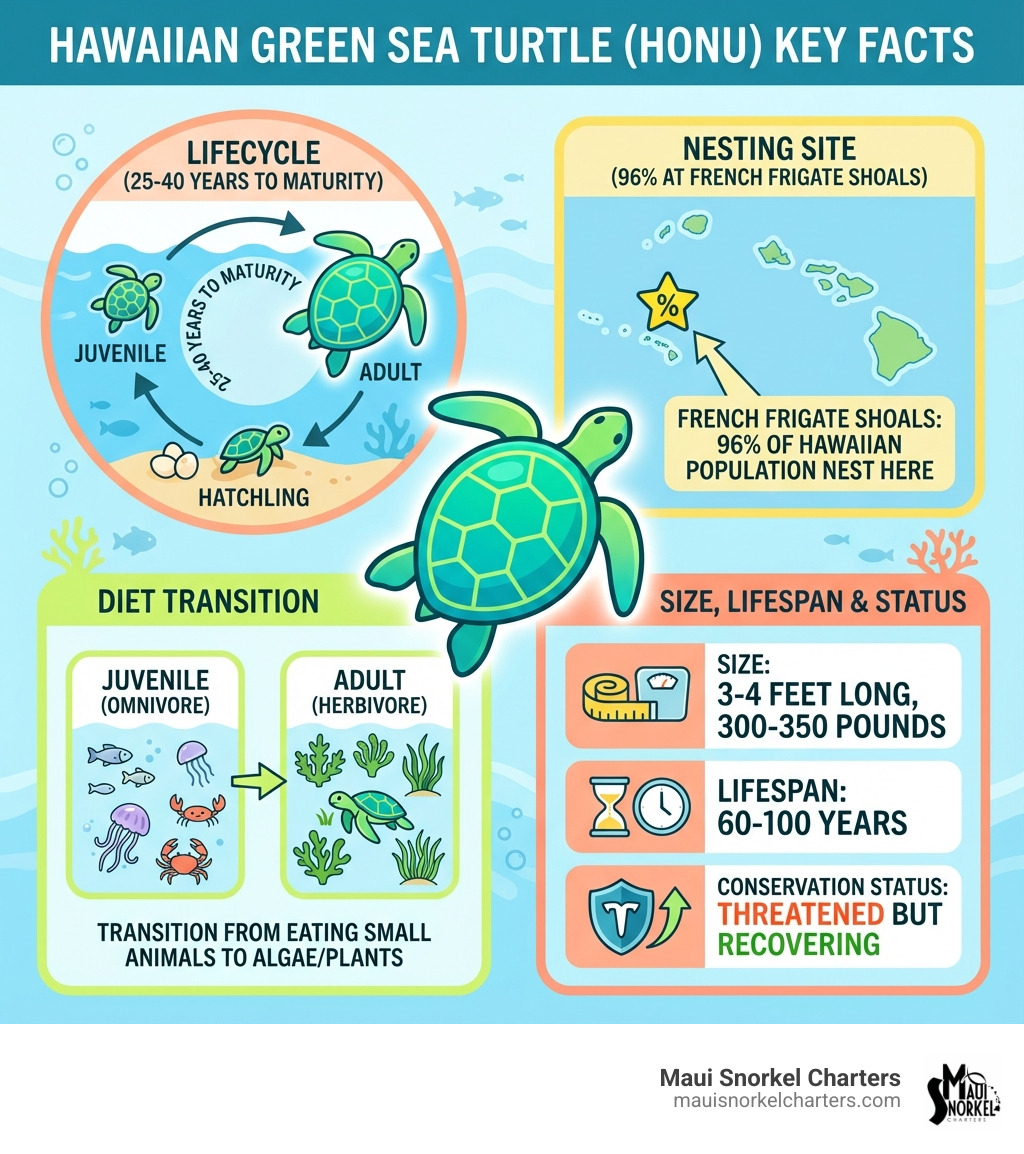
Quick Facts About Hawaiian Green Sea Turtles:
- Scientific Name: Chelonia mydas
- Size: 3-4 feet long, weighing 300-350 pounds
- Lifespan: 60-100 years
- Diet: Herbivorous (adults eat algae and seagrass)
- Conservation Status: Threatened under U.S. Endangered Species Act
- Primary Nesting Site: French Frigate Shoals (96% of Hawaiian population)
- Sexual Maturity: 25-40 years old
- Cultural Name: Honu (sacred guardian in Hawaiian culture)
“The night gives birth to rough-backed turtles.” This line from the ancient Hawaiian creation chant, the Kumulipo, reveals how deeply intertwined honu are with Hawaiian identity. For many Hawaiians, these gentle giants are ‘aumākua—ancestral guardians who guide families.
Today, honu face challenges like disease and marine debris. Yet, their story is one of hope. Thanks to conservation efforts, their numbers are steadily increasing.
This guide covers honu biology, their mysterious “lost years,” and the best places to see them responsibly on Maui. Whether you plan to snorkel at Turtle Town or just want to learn more, you’ll find why protecting honu is vital for Hawaii’s future.
What is a Hawaiian Green Sea Turtle? Anatomy and Habitat
The Hawaiian green sea turtle, or honu, is a star of Maui’s marine life, playing a vital role in the ocean’s ecosystem.
Scientific Name: Chelonia mydas
The scientific name is Chelonia mydas, but in Hawaii, they are affectionately called honu.
Common Name: Honu
“Honu” is the Hawaiian word for green sea turtle, a name that carries immense cultural weight.
Physical Appearance: Size and Weight
Hawaiian green sea turtles are the largest hard-shelled sea turtles. Adults are impressive, measuring 3 to 4 feet long and weighing 300 to 350 pounds.
Shell (Carapace)
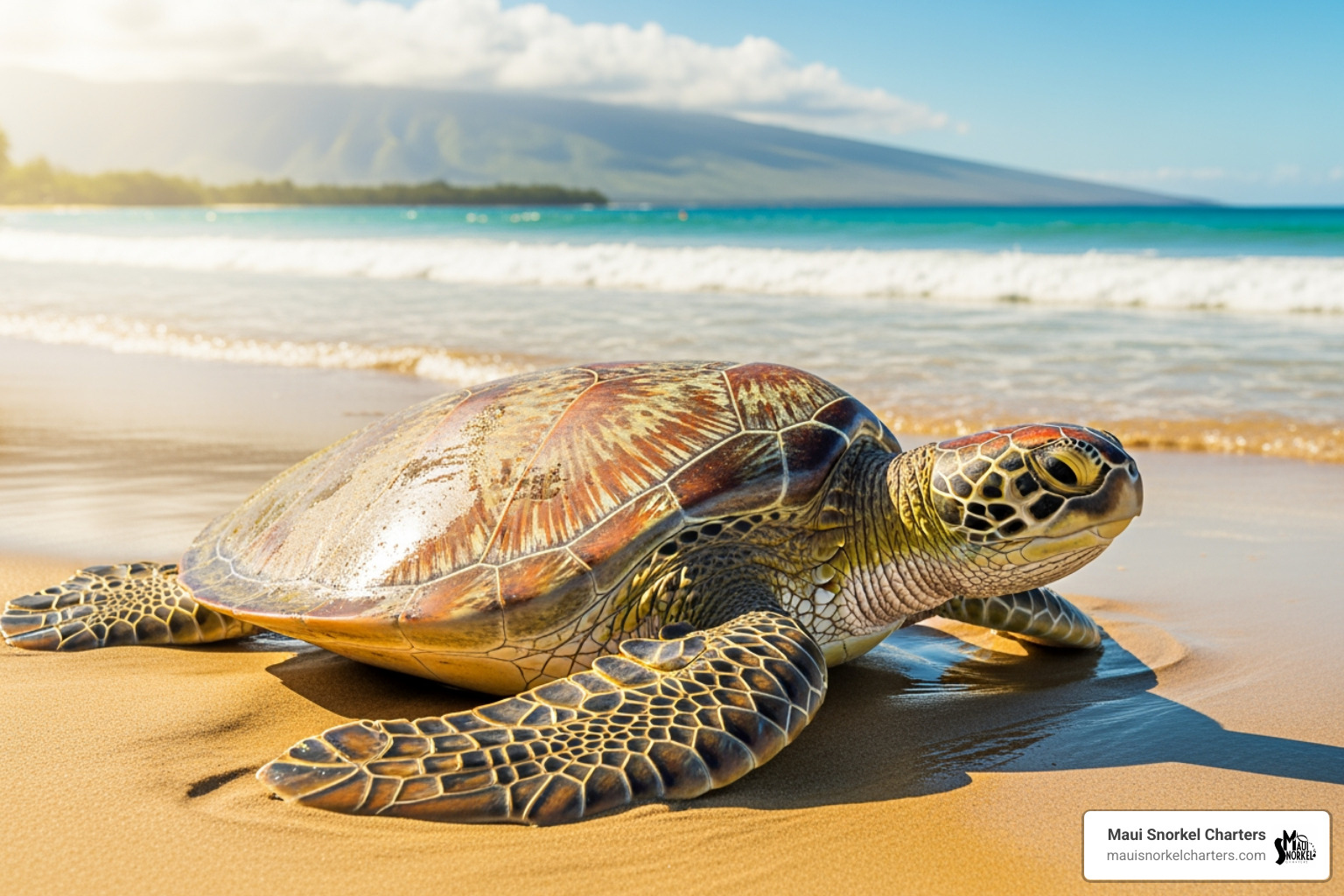
Their carapace (upper shell) is smooth and broad, typically a dark brown, olive, or black color, often with streaks or mottling.
Coloration (Green Fat, Not Shell)
Why are they called green sea turtles? The name refers to their green fat and cartilage, colored by their herbivorous diet of algae and seagrass. The plant pigments they ingest give them this unique coloration.
Table: Comparing Juvenile vs. Adult Honu
| Characteristic | Juvenile Honu | Adult Honu |
|---|---|---|
| Diet | Omnivorous (fish, plants, small invertebrates like sponges and jellyfish) | Primarily Herbivorous (algae, seagrass, occasionally invertebrates) |
| Shell Appearance | Hard black shells as hatchlings, may develop orange/yellowish hues as they grow | Dark brown, olive, or black, often streaked or mottled |
| Size | Small, growing from hatchling size to several feet in length | Large, typically 3-4 feet long, weighing 300-350 pounds |
Habitat and Range
Honu are found in coastal waters around the Hawaiian Islands. Their foraging and basking spots are in Maui’s nearshore waters, though they migrate far for nesting.
Coastal Foraging Areas
Local reefs around Molokini Crater, Turtle Town, and Makena State Park are prime feeding grounds. Here, honu graze on algae (limu) and seagrass, making them the only herbivorous sea turtle species.
Basking Behavior
Uniquely, Hawaiian green sea turtles bask on beaches like those at Makena State Park. This behavior helps regulate body temperature and digestion. It’s a special sight, and we teach our guests to observe them respectfully.
Migratory Patterns to French Frigate Shoals
An astonishing 96% of the Hawaiian green sea turtle population nests at French Frigate Shoals (Lalo) in the Papahānaumokuākea Marine National Monument. Females migrate over 600 miles every two to five years from foraging grounds like Maui to these remote nesting sites, returning after laying their eggs.
Ecological Role: “Sea Cows” of the Reef
Nicknamed the “sea cows” of the reef, their grazing is essential for marine ecosystem health. By eating algae, honu prevent overgrowth that can smother coral reefs. This grazing also promotes healthy seagrass beds, which are crucial habitats for many fish and invertebrates, highlighting the honu’s profound impact on biodiversity.
For more information on the incredible marine life we encounter on our charters, you can explore More info about Animal Life Around Molokini Crater.
The Sacred Honu: Cultural Significance in Hawaiian Tradition
The Hawaiian green sea turtle holds a place of profound reverence in Hawaiian traditions, woven deep into the fabric of Hawaiian identity.

‘Aumākua: Ancestral Spirit Guides
For many Hawaiians, the honu is an ‘aumākua—an ancestral spirit guide or guardian. Believed to embody ancestors, they offer protection and guidance. A wild honu sighting can be a spiritual experience, seen as a blessing from one’s ‘aumākua.
Kumulipo Creation Chant: Honu’s Role in Creation Stories
The Kumulipo, the ancient Hawaiian creation chant, describes the turtle as one of the first creatures born, placing it among the most ancient and respected beings in Hawaiian cosmology.
Mythology and Legends
Hawaiian mythology is rich with honu legends. Some tales depict them as navigators for the first Polynesian voyagers, while others feature them as guardians, like the shape-shifting turtle Kailua. These stories reinforce the honu’s image as a wise, protective presence.
Historical Importance
Historically, honu were revered but also had practical uses. Considered property of the aliʻi (chiefs), they were a source of food, and their shells were used for tools and ornaments. Commercial hunting in the 1900s nearly wiped them out before federal protections led to their recovery.
Modern Reverence
Today, the honu symbolizes good luck, longevity, and the spirit of Hawaii, its image appearing widely in art and local lore. Encountering a honu on our snorkel trips means witnessing a living legend and a symbol of Hawaii’s rich heritage.
A Honu’s Journey: Life Cycle, Reproduction, and the ‘Lost Years’
The life of a Hawaiian green sea turtle is a remarkable odyssey of migration, reproduction, and a mysterious early life stage.
Lifespan and Maturity
Honu are long-lived, with a lifespan of 60 to 100 years. They mature slowly, reaching sexual maturity between 25 and 40 years old, which underscores the importance of long-term protection.
Nesting Migration
Female Hawaiian green sea turtles undertake an epic migration to reproduce. Over 95% of the population travels hundreds of miles from foraging grounds like Maui to the French Frigate Shoals (Lalo). Females make this journey every 2 to 5 years.
Nesting Process
Once at the nesting grounds, a female emerges at night to dig a nest. She can lay 3 to 9 clutches in a season, with each clutch containing 75 to 200 eggs, laid at intervals of about 12 days.
The Unique Reproduction of Hawaiian green sea turtles
Incubation Period
The eggs incubate for 45 to 75 days. The duration depends on sand temperature.
Temperature-Dependent Sex Determination
A fascinating aspect of their reproduction is temperature-dependent sex determination (TSD), where the sand’s temperature determines the sex of the hatchlings. Cooler sand (below 27.7°C / 81.86°F) produces more males, while warmer sand (above 31°C / 88.8°F) produces more females—a critical concern with rising global temperatures. Learn more here: Temperature-Dependent Sex Determination.
Hatchling Frenzy
Hatchlings emerge at night and make a frantic dash for the sea, navigating toward the brightest horizon. Artificial coastal lighting can disorient them, leading them into danger.
Low Survival Rate
Facing numerous predators, only a tiny fraction (as low as 1 in 10,000) survive to adulthood. This low survival rate highlights the need to protect every nest and hatchling.
The Mystery of the ‘Lost Years’
Pelagic Phase
After reaching the sea, young honu enter the mysterious “lost years.” For their first 5 to 10 years, they are rarely seen, drifting in the open ocean (pelagic zone).
Juvenile Diet
During this time, juveniles are omnivorous, eating fish, plants, and small invertebrates. They transition to the adult herbivorous diet of algae and seagrass between ages 5 and 7.
Challenges
This period is challenging. The small turtles face predation, must steer ocean currents, find food, and avoid marine debris. It’s a time of immense growth that shapes them into the powerful swimmers we see today.
Threats and Triumphs: The Conservation of Hawaiian Green Sea Turtles
The story of the Hawaiian green sea turtle is one of both peril and resilience. While they face numerous threats, conservation efforts offer significant hope.
Conservation Status
The Hawaiian green sea turtle is listed as Threatened under the U.S. Endangered Species Act (ESA) and is also protected by state laws (HRS Chapter 195D). While some green sea turtle populations globally have seen recovery, the distinct Hawaiian population remains Threatened, requiring continued local vigilance.
Primary Threats
Honu face significant dangers from human-related activities and environmental changes:
-
Fibropapillomatosis (FP) Disease: This virus causes debilitating tumors that can impair a turtle’s ability to see, move, and feed. It is often linked to poor water quality in degraded marine habitats.
-
Fisheries Interactions: Honu can become hooked or entangled in fishing lines and nets, leading to injury, drowning, or starvation.
-
Coastal Lighting Disorientation: Artificial coastal lighting can deter nesting females and disorient hatchlings, leading them away from the sea to their deaths.
-
Marine Debris: Honu can ingest plastic, mistaking it for food, or become entangled in derelict fishing nets.
-
Boat Strikes: In high-traffic areas, boat strikes can injure or kill turtles when they surface to breathe.
-
Climate Change: Rising sea levels and stronger storms destroy nesting beaches. Warmer sand also skews the sex ratio of hatchlings towards females, threatening long-term reproduction.
Conservation Efforts
Fortunately, many agencies and organizations work to protect honu. State and federal agencies like the Hawaiʻi DLNR, USFWS (turtles on land), and NOAA Fisheries (turtles in water) collaborate on research, monitoring, and recovery plans.
-
Work of Organizations like Hawaii Wildlife Fund: Organizations like the Hawaii Wildlife Fund (HWF) are crucial. They educate the public, monitor turtles, and respond to animals in distress. If you see a stranded or entangled sea turtle on Maui, call the Maui Ocean Center Marine Institute at 808-286-2549.
-
How Individuals Can Contribute: Individuals can help by supporting these organizations through donations or volunteering. Learn more here: What Organizations in Hawaii Offer Volunteer Work Related to Conservation?.
A Story of Hope: Increasing Population Numbers
Despite these threats, there is hope. Decades of conservation have led to a steady increase in the Hawaiian green sea turtle population. Nesting has grown by 5% annually over the last two decades, from just 67 nesting females in 1973 to nearly 500 each year now. This remarkable recovery shows that our actions make a difference.
Honu Encounters: Responsible Viewing and Frequently Asked Questions
Encountering a Hawaiian green sea turtle is a magical experience. To keep it positive for both people and turtles, practice responsible viewing.
The “Rule of Thumb”: Stay at least 10 feet (3 meters) away
The most important rule is to keep a respectful distance. Federal guidelines recommend staying at least 10 feet (3 meters) away, both in water and on land. For basking turtles, 15 feet (5 meters) is even better. We emphasize this on our tours to ensure we observe honu without disturbing them.
List of Best Practices for Turtle Viewing
- Do Not Touch, Feed, or Harass: It is illegal and harmful. This can cause stress, transfer bacteria, and alter their natural behaviors.
- Keep Dogs Leashed: On beaches where honu bask, keep dogs leashed and at a distance.
- Avoid Disturbing Basking or Nesting Turtles: Give turtles on the beach plenty of space. Avoid loud noises, sudden movements, and flash photography.
- Dispose of Trash Properly: Pack out everything you bring to prevent marine debris.
- Be Mindful of Lights: Near the coast during nesting season (May-December), minimize outdoor lighting to avoid disorienting hatchlings.
- Swim Calmly: When near a honu, move slowly. If you remain still, a curious turtle may approach you.
- Report Illegal Activity: Report harassment of sea turtles to the NOAA Hotline (1-800-853-1964) or DLNR’s DOCARE Hotline (1-643-DLNR).
Reporting an Injured Turtle
If you find an injured or entangled turtle, do not help it yourself. Report it immediately to the NOAA Marine Wildlife Hotline at 1-888-256-9840. Provide the location and the turtle’s condition so trained professionals can respond.
Where is the best place to see Hawaiian green sea turtles in Maui?
Maui has many incredible spots to see Hawaiian green sea turtles. We visit these areas on our charters for unforgettable, respectful encounters.
- Turtle Town Maui: This famous area around Maluaka Beach is known for its abundance of honu. The calm, clear water is ideal for snorkeling. Learn more here: What Should I Know Before Visiting Turtle Town Maui?.
- Maluaka Beach: A key part of Turtle Town, this beach offers great opportunities to see honu.
- Makena Landing: Another great spot in Makena, its reefs are home to many honu.
- Honolua Bay: A marine life conservation district with excellent visibility where honu are often seen.
- Molokini Crater: Honu are often seen here, especially around the back wall.
- Kihei Turtle Cleaning Station: A unique spot where turtles gather to be cleaned by fish.
- La Perouse Bay: This rugged bay’s clear waters also attract honu.
- South Maui: The nearshore reefs across South Maui are great for spotting foraging honu.
Why are they called green turtles if their shells are brown?
As mentioned, their name comes not from their brown shells but from their green-colored fat and cartilage, a result of their herbivorous diet.
Is it illegal to touch a green sea turtle in Hawaii?
Yes, it is illegal to touch, harass, or disturb Hawaiian green sea turtles. They are protected by federal and state laws, and violations carry severe penalties, including large fines and potential jail time. We are committed to educating our guests on observing these animals from a distance.
Conclusion: Protecting the Honu for Future Generations
The Hawaiian green sea turtle is deeply intertwined with Hawaii’s culture and ecosystem. From their sacred status as ‘aumākua to their role as reef grazers, honu are indispensable. The honu’s story is a powerful reminder that conservation works. Their increasing numbers are a testament to community dedication and give us hope that our collective actions matter. As we explore Maui’s marine environments, we all have a role in protecting these gentle giants.
How you can help:
- Respect Wildlife: Always maintain a safe distance from honu and other marine life. Observe, but never disturb.
- Reduce Plastic Use: Minimize single-use plastics and participate in beach cleanups.
- Support Sustainable Tourism: Choose tour operators, like us at Maui Snorkel Charters, who prioritize responsible wildlife viewing.
At Maui Snorkel Charters, we are committed to protecting the marine environment. Our local expertise and family values ensure every tour is an unforgettable, educational adventure that fosters respect for ocean life. We invite you to experience the magic of swimming near these gentle giants on a guided tour to Turtle Town, where you can witness their beauty while learning to be a responsible steward of our Hawaiian waters.