
What to Know Before Booking a Lahaina Raft Whale Watching Tour
Lahaina raft whale watching puts you at eye level with some of the ocean’s most impressive animals — humpback whales that migrate over 3,000 miles from Alaska to Maui’s warm waters every winter.
If you’re looking for a quick answer, here’s what matters most:
- Season: December through April (peak: January–March)
- Location: Departs from Mala Ramp, Lahaina, Maui
- Tour length: Typically 2 hours
- Group size: Small groups (16–20 passengers) for a more personal experience
- What you’ll see: Breaches, tail slaps, spy hops, and sometimes whales approaching the raft
- Why a raft: Low-profile vessels sit close to the water, giving you a closer, more intimate perspective than large tour boats
- Regulations: Federal law requires all vessels to stay at least 100 yards from humpback whales
- Guarantee: Many operators offer a “see whales or go again free” policy
About 80% of the North Pacific humpback whale population that travels to Hawaii migrates specifically to Maui. The Maui Nui Basin — the protected channel in front of Lahaina — is one of the best whale watching locations on Earth.
Rafts offer something larger boats simply can’t: an eye-level encounter. You’re close to the surface, in a small group, and positioned exactly where the action happens.
Maui Snorkel Charters is a group of long time Hawaiʻi residents with deep experience guiding guests through Maui’s coastal waters — including lahaina raft whale watching during peak humpback season. Our knowledge of local conditions, whale behavior, and the Maui Nui Basin shapes every tour we run.
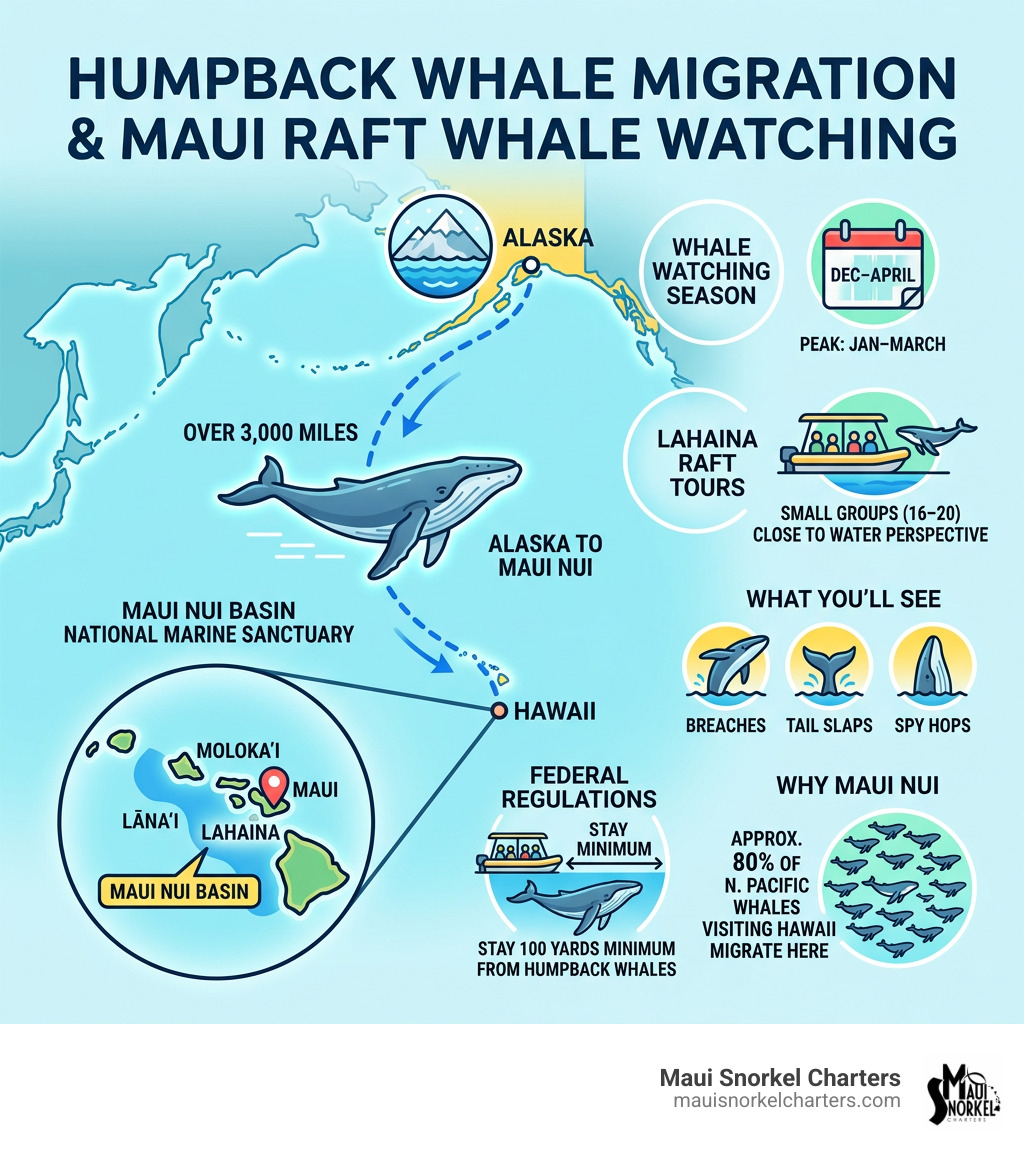
Key terms for lahaina raft whale watching:
Why Choose Lahaina Raft Whale Watching with Maui Snorkel Charters
When you are deciding how to see the Kohola (humpback whales), the vessel you choose changes everything. While large catamarans have their place, we believe that lahaina raft whale watching is the gold standard for anyone wanting a true connection with nature.
At Maui Snorkel Charters, we focus on the “No Ka Oi” experience—which means “the best.” By using agile, low-profile rafts, we provide a perspective that makes a 40-ton whale feel like a neighbor rather than a distant spectacle.
- Eye-level viewing: On a raft, you aren’t looking down from a high deck. You are sitting just a few feet above the water line. When a whale breaches or spy hops nearby, you are seeing them at their level.
- Small group sizes: We keep our groups small, typically between 16 and 20 passengers. This means no fighting for a spot at the railing. Every seat is a front-row seat.
- Speed and Agility: Rafts are much faster than larger boats. If whales are spotted a mile away, we can get there quickly and safely, maximizing your actual viewing time.

The Advantage of Eye-Level Whale Watching from a Raft
The most common feedback we hear after a lahaina raft whale watching tour is how “close” the whales felt. Because the raft has a low profile, the water feels like an extension of the boat. This intimate perspective is a dream for photographers. You don’t have to zoom in across a football field of water; the whales are right there in your frame.
Sometimes, we experience what locals call a “mugging.” This happens when a curious whale decides to approach our stationary raft. Because we follow all federal regulations and keep our engines neutral, the whales often feel comfortable enough to swim right alongside us, looking up at the passengers. It is a humbling experience that often leaves the whole boat in silent awe.
Small Group Experience and Local Marine Naturalist Guidance
We don’t just take you to the whales; we help you understand them. Our tours are led by experienced crew members who act as marine naturalists. They can explain why a male is singing, why a mother is teaching her calf to slap its pectoral fin, or what a “competition pod” signifies.
To enhance this, we use underwater hydrophones. Humpback whale songs can span up to 8 octaves and can be heard for miles underwater. Dropping the hydrophone into the Maui Nui Basin allows us to broadcast these hauntingly beautiful songs directly through the boat’s speakers. It adds a whole new layer to the adventure.
Want a more personal whale encounter?
See upcoming Lahaina raft whale watching trips
Planning Your Lahaina Raft Whale Watching Trip
Timing is everything when it comes to seeing the giants of the Pacific. While you might see a stray whale in late October, the official lahaina raft whale watching season runs from December 1st through April.
If you want the absolute highest density of whales, aim for January, February, or March. During these months, the Maui Nui Basin is teeming with mothers, calves, and males looking for mates.
- Morning Tours: These are generally the most popular because the trade winds are usually calmer in the morning. Flatter water makes it much easier to spot a blow (the misty spray from a whale’s blowhole) from a distance.
- Afternoon Tours: While the water might be a bit choppier, the lighting in the afternoon is spectacular for photos, and the whales are just as active. Whales don’t follow a clock—they are active 24 hours a day!
Check out the best time to see whales in Hawaii for a deeper dive into seasonal patterns.
Common Humpback Whale Behaviors Seen in Lahaina
When you’re out on a raft, you’ll likely see a variety of behaviors. Each one tells a story about what the whale is doing:
- Breaching: This is the “holy grail” of whale watching. A 40-ton whale launches its entire body out of the water. It’s loud, it’s splashy, and it’s unforgettable.
- Spy Hopping: The whale pokes its head straight up out of the water to look around. On a raft, it often feels like the whale is making eye contact with you.
- Tail Slaps (Peduncle Slaps): Whales often slam their massive tails against the surface. This can be a form of communication or a way to ward off other males.
- Pectoral Fin Slaps: Whales have fins that can be up to 15 feet long. They love to roll on their sides and slap these fins against the water, creating a rhythmic “thwack” that carries for miles.
Learn more about Maui’s humpback whales to prepare for your trip.
Understanding Maui Whale Migration Patterns
Why do they come here? It’s a 3,000-mile journey from the nutrient-rich feeding grounds of Alaska. They make this trek every year to reach the warm, shallow, and protected waters of the Maui Nui Basin.
In Hawaii, they don’t eat. They are here strictly to mate, give birth, and nurse their young. The shallow waters between Maui, Lanai, and Molokai act as a natural nursery, protecting calves from predators and providing a calm environment for them to gain the strength needed for the swim back north.
Hawaii whale migration patterns explained
Essential Logistics for Your Lahaina Raft Tour
A typical lahaina raft whale watching excursion lasts about 2 hours. This is the perfect amount of time to get out into the heart of the sanctuary, find several different pods, and enjoy the educational commentary without feeling rushed.
Currently, most tours depart from the Mala Ramp in Lahaina. This location has become the primary hub for ocean recreation following the 2023 wildfires. It offers easy access to the deep waters where whales congregate just offshore.
Safety Guidelines and Participant Requirements
We take safety seriously—both yours and the whales’.
- The 100-Yard Rule: Federal law, overseen by NOAA Fisheries, prohibits any vessel from approaching within 100 yards of a humpback whale. If a whale swims toward us, we put the engines in neutral and wait for them to pass. This ensures we aren’t stressing the animals.
- Health Restrictions: Because rafts are adventure-style vessels that sit low to the water, they can be a bit “zippy.” We do not recommend these tours for pregnant women, children under the age of 3, or anyone with chronic back or neck injuries.
- What to Bring: You will get a little bit of sea spray. Bring a light jacket or windbreaker, a hat (with a chin strap!), polarized sunglasses, and reef-safe sunscreen.
What Makes Raft Tours Unique with Maui Snorkel Charters
| Feature | Maui Snorkel Charters Raft Tours | Large Catamaran Tours |
|---|---|---|
| Group Size | 16–20 guests | 60–150 guests |
| Water Proximity | Eye-level, close to surface | High deck, looking down |
| Experience | Intimate, personalized | Crowd-focused |
| Mobility | Agile, can reposition quickly | Slower, harder to turn |
| Audio | Direct hydrophone listening | General PA system |
Prefer a small-group, up-close experience?
Book your Lahaina raft whale watch with Maui Snorkel Charters
Supporting Local Lahaina Whale Watching Businesses
The Lahaina community is resilient. By booking a lahaina raft whale watching tour, you are directly supporting local families and captains who have spent their lives on these waters. Many operators lost their homes and offices in the 2023 fires, but their passion for the ocean remains.
Departing from Mala Ramp is a great way to see the beauty of West Maui while contributing to the economic recovery of the town. We are proud to be part of this community and to share the healing power of the ocean with our guests.
The Importance of the Maui Nui Basin Sanctuary
The waters you’ll be traversing are part of the Hawaiian Islands Humpback Whale National Marine Sanctuary. Established in 1992, this sanctuary is critical for the survival of the species.
Approximately 80% of the North Pacific humpback whale population gathers here. The basin’s unique geography—sheltered by four islands—creates a “lake-like” environment in the middle of the Pacific Ocean. This calm water is essential for newborn calves who don’t yet have the blubber or strength to handle heavy ocean swells.
Protecting Humpback Whales for the Future
Conservation is at the heart of what we do. When you join a lahaina raft whale watching tour, you become an ambassador for these animals.
- Eco-Conscious Operations: We use fuel-efficient engines and strictly adhere to sanctuary guidelines.
- Research Support: Many raft operators collaborate with researchers by reporting sightings and behavior patterns, helping scientists track the health of the North Pacific population.
- Guest Education: By teaching you about the whales, we hope you’ll take that knowledge home and support ocean conservation efforts globally.
Frequently Asked Questions about Lahaina Raft Whale Watching
What is the best time of day for whale watching in Lahaina?
Whales are active 24/7! However, for human comfort, the morning (7:00 AM to 10:00 AM) is often best because the winds are lighter and the sea is calmer. If you want a dramatic backdrop, sunset tours offer incredible colors, though the water can be a bit choppier.
Are raft tours suitable for people prone to seasickness?
Rafts are actually quite stable because they have a low center of gravity and pontoon-style sides that “grip” the water. However, if you are very sensitive to motion, we recommend taking a preventative like ginger or consulting your doctor before the trip.
What should I bring on a Lahaina raft whale watching tour?
The essentials are polarized sunglasses (to see through the water’s surface), a camera (GoPros are great!), reef-safe sunscreen, and a light waterproof jacket. Don’t bring anything that can’t get a little wet!
Will I see other animals?
While humpbacks are the stars, it’s very common to see Spinner Dolphins, Bottlenose Dolphins, and Green Sea Turtles. Occasionally, we even spot rare species like False Killer Whales or Whale Sharks!
What is a “Guaranteed Sighting” policy?
Most reputable operators in Lahaina are so confident you’ll see whales during peak season that they offer a guarantee. If you don’t see a whale on your trip, you’ll receive a voucher to come back again for free.
Conclusion
There is no experience quite like being on a small raft, engines off, listening to the rhythmic breathing of a humpback whale just a hundred yards away. Lahaina raft whale watching offers an intimate, educational, and thrilling look at Maui’s gentle giants that you simply can’t get on a larger boat.
At Maui Snorkel Charters, we are dedicated to providing a safe, respectful, and “No Ka Oi” adventure for every guest. Whether it’s your first time seeing a whale or your fiftieth, the magic of the Maui Nui Basin never fades.
Ready to see the whales?
Check availability for our Maui snorkeling and whale watching excursions