WHALE SEASON BEGINS DEC 15 • EARLY BOOKING OPEN
Fish identification
Muraenidae • multiple species · Puhi
A moray peering from a reef crevice can be an unforgettable observation. Morays are fish, and different species have different markings and feeding equipment. Learn the differences without reaching into shelter or trying to draw an animal out for a photograph.
Bony fishes
Muraenidae
Puhi
Reef crevices and ledges
Morays are adapted to moving and hunting in reef spaces. A visible head may be only a small part of the animal. Keep hands and equipment away from crevices; shelter is not an invitation to investigate by touch. [1]
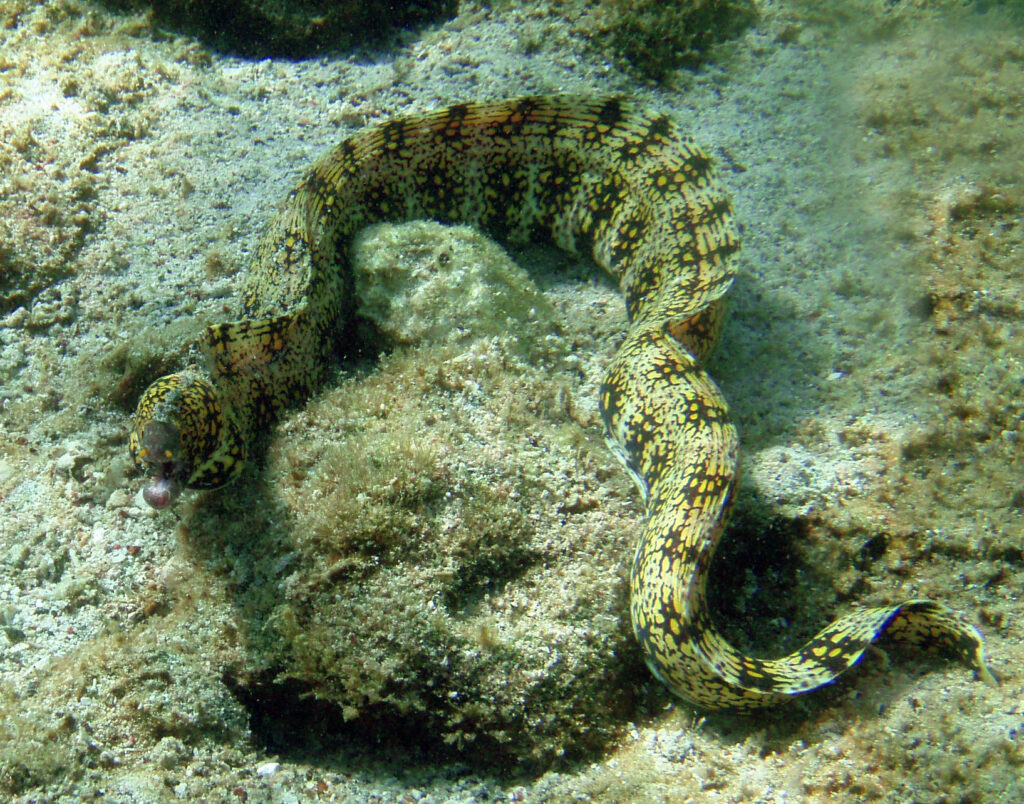
Snowflake morays show a distinctive pale pattern with dark blotches, while zebra morays have contrasting bands. Their blunt crushing teeth suit hard-bodied prey such as crustaceans and mollusks. These are not interchangeable color forms of a single eel. [2]
The yellow-margin moray, Gymnothorax flavimarginatus, is a larger fish-eating Hawaiian example with a yellow border near the tail. Fish-eating morays have different teeth from the crushing dentition of snowflake and zebra morays. A full pattern and body view helps identification. [1]
Do not offer food to make an eel emerge, reach into a hole or crowd the animal’s shelter. Stay buoyant and avoid resting a hand on the reef to hold a camera steady. A glimpse in natural surroundings is preferable to a staged close-up.
Morays, octopuses and lobsters use the same reef landscape in different ways. Explore the connected guides to understand a sighting, while following your crew’s route and staying out of unsafe or restricted spaces. The animals you see vary naturally.
No. It is a fish.
No. Different species have different diets and teeth; some specialize in hard-bodied invertebrates.
No. Leave the animal and its shelter undisturbed.
Research sources checked November 16, 2026. Wildlife timing, appearance and sightings vary. This guide is not a live sighting report.
Ocean adventures from Kihei, Maui
Snorkeling · Molokini · Whale Watching · Sunset Cruises
© Maui Snorkel Charters. Routes and wildlife encounters vary with ocean conditions.
We use necessary cookies to run this site and provide the services you request. With your permission, we also use statistics cookies to understand visits and optional services such as maps and videos. You can accept, reject optional cookies, or change your choices at any time.